The saxophone is both a delicate and complex instrument.
For it to perform at its very best, careful and consistent maintenance is essential.
Regular maintenance not only extends its lifespan, but also ensures responsive keys, well-maintained pads, and a stable, reliable tone every time you play.
In this guide, we will explore the essential daily cleaning steps, the recommended maintenance intervals, and the key products every saxophonist should keep close at hand to maintain their instrument in perfect condition.
General Cleaning and Maintenance Routines
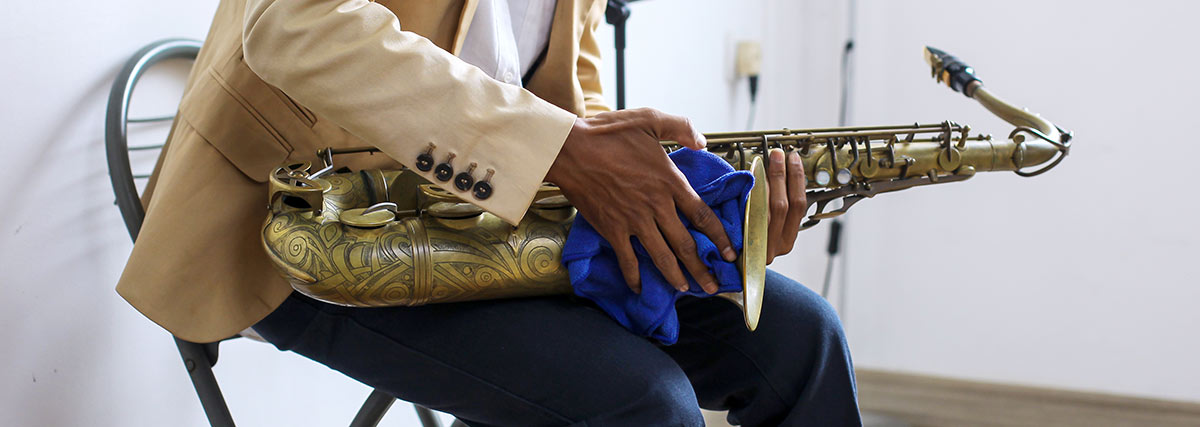
Careful daily care is the foundation of a high-performing and long-lasting saxophone.
Before playing, it is advisable to apply cork grease regularly. This helps prevent cracks, makes assembling and dismantling the instrument easier, and ensures a smooth and secure fit.
After each practise session or performance, the inside of the saxophone should be swabbed to remove any accumulated moisture.
This simple habit helps to prevent corrosion and protect the pads.
The exterior also deserves gentle cleaning with a soft cloth: fingerprints, dust, and residue can dull the lacquer and affect the instrument’s overall appearance.
The pads require particular attention.
Removing excess moisture with absorbent paper or a thin cloth helps prevent the keys from sticking and extends their lifespan.
Finally, the reed should not be overlooked.
It should be stored in a suitable case to maintain a stable level of humidity and prevent any warping.
A worn reed should be replaced promptly to preserve a consistent tone and ensure a good response from the instrument.
By adopting these simple and consistent habits, the saxophonist protects their instrument and enjoys a more stable, comfortable, and reliable playing experience.
Recommended Maintenance Schedule
Even with meticulous daily cleaning, a saxophone will inevitably change over time.
Changes in temperature and humidity, repeated assembly and dismantling, as well as hours of playing, gradually affect the mechanism.
The keys may loosen, certain screws may shift slightly, the pads may compress, and small air leaks may appear.
Often imperceptible at first, these changes nonetheless affect intonation, response, and tone quality, making the instrument more difficult to control.
This is why regular professional servicing is just as essential as daily cleaning.
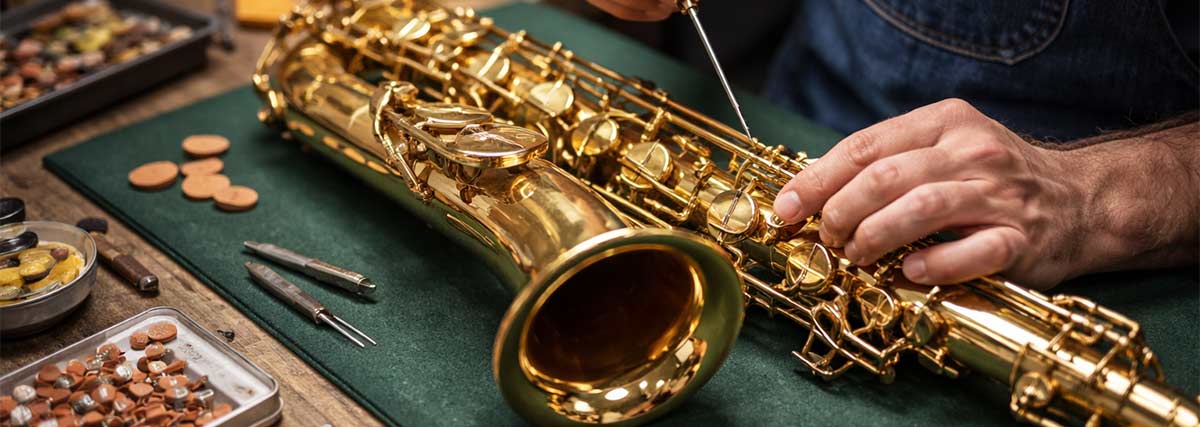
As a general rule, having your saxophone checked by a technician every three to four months is a wise investment, particularly for musicians who play regularly.
The technician can check the overall regulation, tighten the keys, replace worn pads or corks, adjust the spring tension, oil the mechanism, and ensure the instrument remains airtight.
These preventative measures make playing smoother and often restore a clarity of tone you may not have realised had faded.
They also help to avoid many frustrations: certain difficulties that one might attribute to one’s own ability — unstable notes, lack of response, difficulty in softer dynamics — are sometimes simply mechanical in origin.
For musicians based in Paris, I personally recommend Le Cave à Vent on Rue de Rome, recognised for its efficiency, reasonable prices, and high-quality workmanship.
Finding a trusted technician and scheduling regular check-ups can significantly improve your playing comfort.
Maintenance should therefore not be seen as an occasional repair, but as a natural routine, just like daily practise.
Essential Products to Always Keep with You
Beyond daily routines and visits to the technician, having a few basic tools at home helps to prevent many minor issues.
These accessories do not replace a professional, but they help keep the instrument in good condition between services.
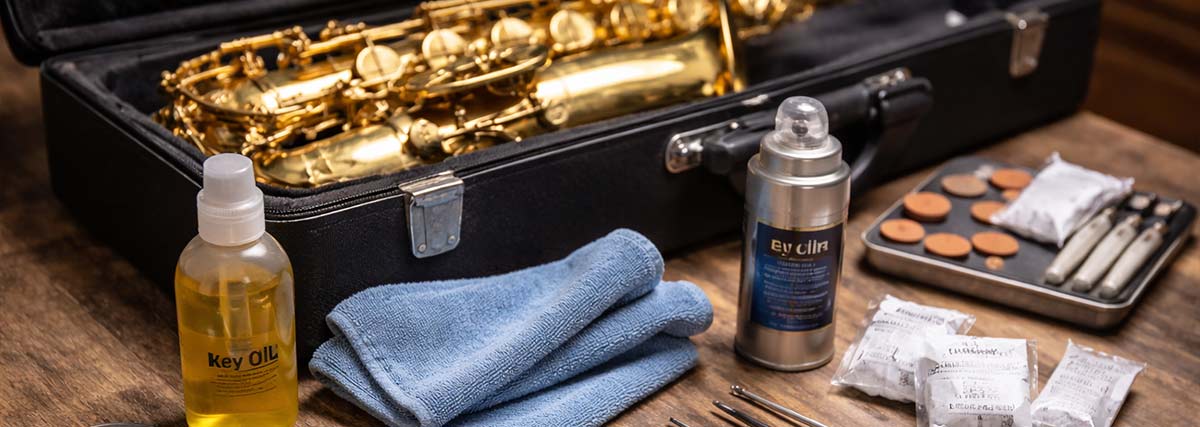
Key oil is essential.
The saxophone’s mechanism includes many metal parts in constant motion; a light lubrication reduces friction, limits wear, and ensures a smooth and quiet action.
Used sparingly, it significantly improves playing comfort.
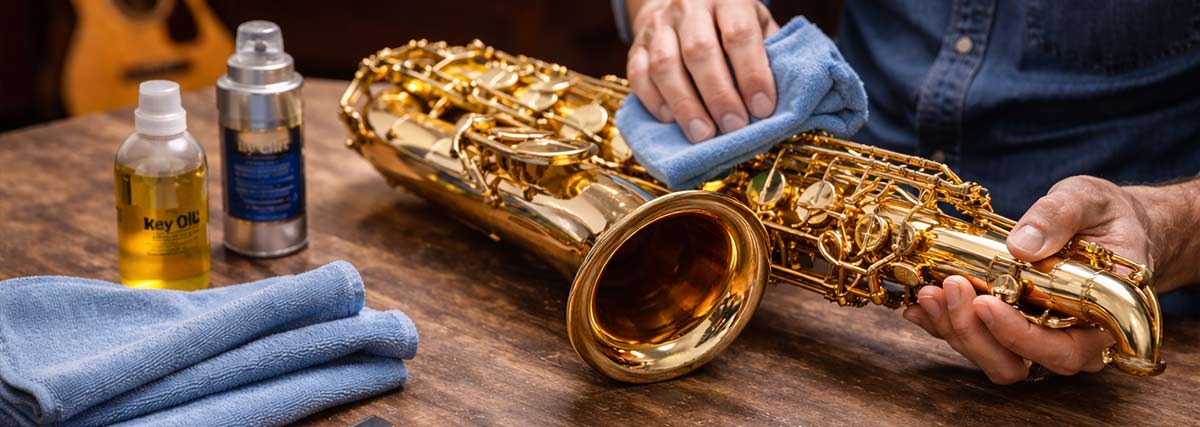
For the exterior, a specialised polish spray used with a microfibre cloth helps protect the lacquer or plating against oxidation and the early onset of rust.
Occasional cleaning helps maintain the instrument’s shine, particularly for those who frequently play under warm stage lighting or outdoors.
A small set of screwdrivers designed for woodwind instruments can also prove useful.
With vibration, certain screws naturally loosen; being able to tighten them carefully allows you to correct minor mechanical issues quickly. More complex adjustments, however, should always be entrusted to a specialist.
Some musicians also use a leak light or test paper to check the seal of the pads. Even the smallest air leak can affect intonation and response; detecting these issues early makes repairs much easier.
Finally, storage plays a crucial role. Anti-moisture sachets or silica gel placed inside the case help stabilise the internal environment and protect the pads, corks, and felts.
Together, these tools form a simple yet effective kit for ensuring the instrument’s long-term reliability.
Conclusion
Keeping a saxophone in perfect condition is not about a single action, but about consistent care and attention.
From daily cleaning to regular professional servicing, and the use of appropriate tools, every small action contributes to the overall health of the instrument.
These habits may seem modest, but their impact is considerable: improved tone quality, a more reliable mechanism, and greater playing comfort.
A well-maintained saxophone responds more easily, sounds clearer, and allows the musician to focus fully on what truly matters — the music.
In this sense, maintenance is not merely about preserving an object, but about safeguarding one’s own artistic expression.
Taking care of your instrument should become as natural as warming up or tuning before you play. With regular and preventative attention, your saxophone will remain stable, reliable, and ready to accompany you for many years of music.
If you would also like to learn to play this instrument, you can discover our saxophone lessons in Paris, open to adults of all levels.
A German version of this article is also available on the website of the Dolce Musik Institut in Berlin.
Read the German version here:
Saxophone Care and Maintenance

About the Author: So Wai
The saxophone is both a delicate and complex instrument.
For it to perform at its very best, careful and consistent maintenance is essential.
Regular maintenance not only extends its lifespan, but also ensures responsive keys, well-maintained pads, and a stable, reliable tone every time you play.
In this guide, we will explore the essential daily cleaning steps, the recommended maintenance intervals, and the key products every saxophonist should keep close at hand to maintain their instrument in perfect condition.
General Cleaning and Maintenance Routines
Careful daily care is the foundation of a high-performing and long-lasting saxophone.
Before playing, it is advisable to apply cork grease regularly. This helps prevent cracks, makes assembling and dismantling the instrument easier, and ensures a smooth and secure fit.
After each practise session or performance, the inside of the saxophone should be swabbed to remove any accumulated moisture.
This simple habit helps to prevent corrosion and protect the pads.
The exterior also deserves gentle cleaning with a soft cloth: fingerprints, dust, and residue can dull the lacquer and affect the instrument’s overall appearance.
The pads require particular attention.
Removing excess moisture with absorbent paper or a thin cloth helps prevent the keys from sticking and extends their lifespan.
Finally, the reed should not be overlooked.
It should be stored in a suitable case to maintain a stable level of humidity and prevent any warping.
A worn reed should be replaced promptly to preserve a consistent tone and ensure a good response from the instrument.
By adopting these simple and consistent habits, the saxophonist protects their instrument and enjoys a more stable, comfortable, and reliable playing experience.
Recommended Maintenance Schedule
Even with meticulous daily cleaning, a saxophone will inevitably change over time.
Changes in temperature and humidity, repeated assembly and dismantling, as well as hours of playing, gradually affect the mechanism.
The keys may loosen, certain screws may shift slightly, the pads may compress, and small air leaks may appear.
Often imperceptible at first, these changes nonetheless affect intonation, response, and tone quality, making the instrument more difficult to control.
This is why regular professional servicing is just as essential as daily cleaning.
As a general rule, having your saxophone checked by a technician every three to four months is a wise investment, particularly for musicians who play regularly.
The technician can check the overall regulation, tighten the keys, replace worn pads or corks, adjust the spring tension, oil the mechanism, and ensure the instrument remains airtight.
These preventative measures make playing smoother and often restore a clarity of tone you may not have realised had faded.
They also help to avoid many frustrations: certain difficulties that one might attribute to one’s own ability — unstable notes, lack of response, difficulty in softer dynamics — are sometimes simply mechanical in origin.
For musicians based in Paris, I personally recommend Le Cave à Vent on Rue de Rome, recognised for its efficiency, reasonable prices, and high-quality workmanship.
Finding a trusted technician and scheduling regular check-ups can significantly improve your playing comfort.
Maintenance should therefore not be seen as an occasional repair, but as a natural routine, just like daily practise.
Essential Products to Always Keep with You
Beyond daily routines and visits to the technician, having a few basic tools at home helps to prevent many minor issues.
These accessories do not replace a professional, but they help keep the instrument in good condition between services.
Key oil is essential.
The saxophone’s mechanism includes many metal parts in constant motion; a light lubrication reduces friction, limits wear, and ensures a smooth and quiet action.
Used sparingly, it significantly improves playing comfort.
For the exterior, a specialised polish spray used with a microfibre cloth helps protect the lacquer or plating against oxidation and the early onset of rust.
Occasional cleaning helps maintain the instrument’s shine, particularly for those who frequently play under warm stage lighting or outdoors.
A small set of screwdrivers designed for woodwind instruments can also prove useful.
With vibration, certain screws naturally loosen; being able to tighten them carefully allows you to correct minor mechanical issues quickly. More complex adjustments, however, should always be entrusted to a specialist.
Some musicians also use a leak light or test paper to check the seal of the pads. Even the smallest air leak can affect intonation and response; detecting these issues early makes repairs much easier.
Finally, storage plays a crucial role. Anti-moisture sachets or silica gel placed inside the case help stabilise the internal environment and protect the pads, corks, and felts.
Together, these tools form a simple yet effective kit for ensuring the instrument’s long-term reliability.
Conclusion
Keeping a saxophone in perfect condition is not about a single action, but about consistent care and attention.
From daily cleaning to regular professional servicing, and the use of appropriate tools, every small action contributes to the overall health of the instrument.
These habits may seem modest, but their impact is considerable: improved tone quality, a more reliable mechanism, and greater playing comfort.
A well-maintained saxophone responds more easily, sounds clearer, and allows the musician to focus fully on what truly matters — the music.
In this sense, maintenance is not merely about preserving an object, but about safeguarding one’s own artistic expression.
Taking care of your instrument should become as natural as warming up or tuning before you play. With regular and preventative attention, your saxophone will remain stable, reliable, and ready to accompany you for many years of music.
If you would also like to learn to play this instrument, you can discover our saxophone lessons in Paris, open to adults of all levels.
A German version of this article is also available on the website of the Dolce Musik Institut in Berlin.
Read the German version here:
Saxophone Care and Maintenance
Share this article!
Women and the Saxophone: Emerging Voices Shaping the Future of the Instrument
The history of the saxophone is filled with legendary names—Marcel Mule, Stan Getz, Charlie Parker—and they all have one thing in common: they are men. From the classical stage to jazz clubs, [...]
Portrait of Olivier Messiaen and His Musical Language Through Time
Born on 10 December 1908 in Avignon, France, Messiaen became a major composer of 20th-century music. He was the son of Pierre Messiaen, a literature professor who... [...]
Learning the Violin: A Demanding Journey Guided by Relaxation
The violin is often considered one of the most difficult instruments to learn. It requires great precision, a keen ear, and subtle coordination between the hands. Yet, at its core... [...]
What makes the saxophone unique among wind instruments?
As a saxophonist, I often hear amused remarks from other musicians claiming that the saxophone belongs to the brass family—a common misunderstanding due to its appearance [...]
Improving breath control and lung capacity as a beginner saxophonist
Breath control is one of the major challenges for beginner saxophonists. Many struggle to sustain long phrases and run out of breath before completing a musical line. Without proper technique, [...]
History of the Double Bass
The double bass emerged in 1620, succeeding the violone and the violone bass, but it was not introduced into the orchestra until the mid-17th century. It was first used in an orchestra [...]
SIMILAR ARTICLES
When the Saxophone Became the Voice of 1980s Hong Kong Pop
What makes the saxophone unique among wind instruments?
Improving breath control and lung capacity as a beginner saxophonist
The History of the Saxophone: From Classical to Jazz
Join Paris’ most distinguished music academy for adults
Exclusive music instruction for adults of all ages and abilities (absolute beginners are very welcome!)